
There are many ways to leave a mark. Or not to leave one.
Some people prefer to remain in the shadows and let their actions speak for themselves. Parents leave a mark on their children, stronger than any signature carved into titanium. But they rarely leave a trademark.
Artists are recognized by their style and, if they manage to make their audience’s hearts vibrate with the same emotions with which they created their work, they survive beyond their death and continue to resonate through generations.
There are invisible but well-known traces, and visible marks left by strangers. In some caves, the handprints of prehistoric men and women can still be seen. No one knows their names or their stories, yet they are there, marking a fixed point in History and prompting thoughts and reflection.
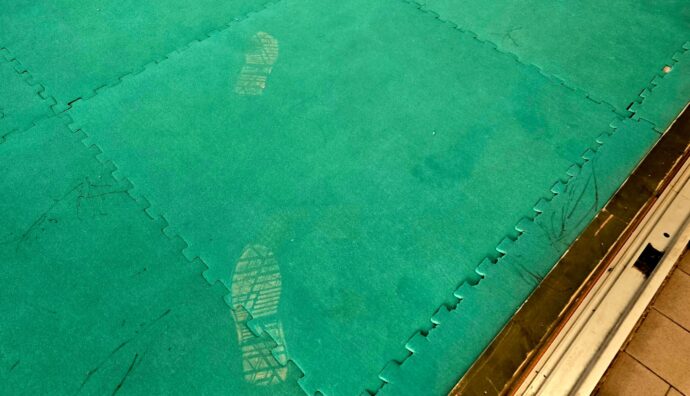
There are also marks like the ones in the photo accompanying this post. The footprints of adults’ shoes on “our” little tatami.
That makes you think. And it hurts, too.
Not so much because of the dirt itself. That can be cleaned: we have a cleaning kit that we use to ensure that the place is kept clean and hygienic for everyone who uses it.
It hurts because it is yet another small but significant sign of unawareness.
We are not judging the act. Maybe there was a reason for going in. Maybe there was no opportunity to clean up. Maybe it was not done out of disrespect. Maybe they did not even know that children, teenagers, and adults put their faces down there.
That is not the point.
The point is that we are living through a historical period—as with every other historical period, except that this one is affecting us more directly—in which we are seeing the effects of individualism taken to the extreme.
A period in which society is permeated by a sense of dissatisfaction, by desires for well-being, fairness, and justice which, when they find an outlet and are given expression, often manifest themselves through angry retaliation and angry, partisan outbursts.
We loudly demand respect and dialogue and yet, as a society—as all we have to do is look at ourselves in front of a smartphone—we respond with soliloquies and crude, football-ultra-style slogans.
So, leaving dirt from work boots on a tatami and not even realizing it, without cleaning it up, is not the same thing as invading Ukraine, arguing over fuel taxes, or fighting over electoral law… Of course, there are worse things.
And yet, if we look closely, while it is certainly true that we cannot go out from here and convince those in power of the need for peace, of the madness of continuing military actions that increase barbarity and impoverish everyone, it is equally true that there is something we can do.
For example, not getting things dirty where other people put their faces.
How can we aspire to sort out complex issues—national, global ones—when we are incapable of showing that minimum level of sensitivity right where we are? How can we change things?
In John Rambo there is a scene that explains with stark realism the answer History has always given to this bizarre way of living of ours: attentive to global issues and desperately indifferent to what is within arm’s reach:
There are two primary temptations.
The first is force. “Do you have any weapons?” Rambo asks. When the obvious answer is no, comes the bitter yet equally obvious realization that then, nothing will ever change.
The second is to send everyone to where Rambo sends the world in this clip. Because you try. And you try again. And you try yet again. But the evidence is right there. Someone comes along and leaves their mark.
On your tatami. On your emotions. On your time.
And yet.
If we are truly serious when we talk about the brutalization of society.
If we still have that little bit of self-respect that makes us demand some meaning from what we do, and if we are still able to recognize value in others, then force and indifference are not viable options. They cannot be.
Because they would lead us to walk in with dirty shoes ourselves into places where, before, we would never have done so.
“Hurting an opponent means hurting yourself. Controlling aggression without causing injury is the Art of Peace,” said Morihei Ueshiba.
How difficult it is to leave the imprint of a caress rather than a slap.
That is why we step onto a tatami every day. Whether it is dirty or clean.