
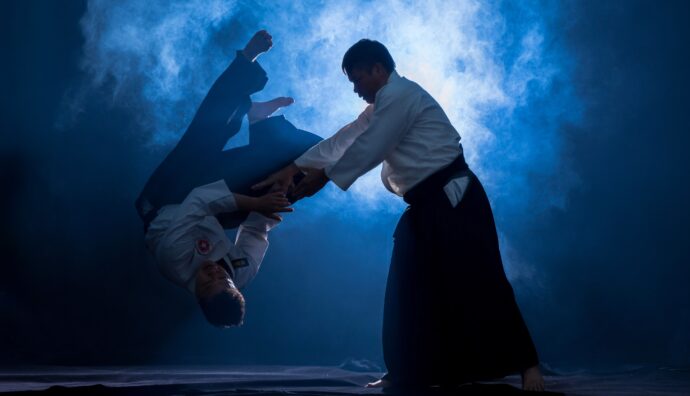
In one of the very few interviews he has given, Mitsuteru Ueshiba reflected a few years ago on the future of Aikido. The great-grandson of Aikido’s Founder argued that times change and that, precisely for this reason, the essence of a discipline must always remain the same.
The history of Aikido and its spread throughout the world has been anything but linear, as is the history of any innovation. Yet there is undoubtedly something that captured the interest and touched the hearts of Morihei Ueshiba’s earliest students, just as it continues to do for those who will step into a Dojo for the first time tonight.
It is all too easy to dismiss this something with the word “tradition”. There is, after all, a central core of values and an evolving pedagogy that attracts, fascinates, and supports personal development. Yesterday, just as today.
From its very beginnings, Aikido was not created to establish who is the strongest, but to transform our relationship with conflict. Its practice is not aimed at defeating an opponent; rather, it seeks to foster awareness, personal development through relationships, and the pursuit of harmony. It works on the ego, challenged by the stress of conflict, in order to cultivate a less… self-centred relationship with oneself and with others.
It is from this distinction that we can reflect on the meaning of two terms from the Japanese martial tradition: shiai and enbukai. Bringing these two concepts together allows us to identify a possible direction for Aikido: moving beyond competition as the primary measure of confrontation and embracing demonstration and shared experience as the art’s principal means of expression.
The term shiai (試合) refers to a contest or competitive match. The match takes place according to established rules and produces a result: a winner and a loser.
This logic is inherent in competitive sport, where measuring performance and determining who prevails are essential parts of the activity. Making victory the objective introduces a point at which the underlying logic becomes contradictory: the partner, indispensable to learning, becomes someone to be defeated.
Those accustomed to practising combat sports will argue that it is precisely through the many defeats and victories, both made possible by the presence of an opponent, that progress can be achieved.
From the perspective of Aikido’s Founder, a perspective that has been passed down to his great-grandson, this contradiction becomes decisive. Most likely, the combined effect of the trivialisation of Aikido through its Western-style sportification, on the one hand, and the idea of victory achieved by overpowering and injuring an opponent, on the other, lies at the root of this conviction, which has endured to the present day.
In 合気道技法 — Aikido Giho, a publication authored by Kisshomaru Ueshiba, with his father Morihei credited as editorial supervisor, the prohibition of competitions (shiai) is explicitly stated for the first time.
The reasoning behind this position resonates with the “Memories of the Founder” compiled by his son and published posthumously. In one passage, which strongly reflects the influence of new religions with nationalist and unifying ideals, such as Oomoto-kyo, we read:
The purpose of Aikido—and the noble spirit upon which to build a universal order—is not to invade a nation or take a life; rather, it is to ensure that every individual finds their rightful place and is able to flourish. It seeks to unite humanity into one great global family, in which each person acts as an integral part of a unified whole, contributing through their own particular role. This, I believe, was the profound vision of Emperor Meiji. Through constant prayer, we strive to prevent conflict; this is why Aikido strictly prohibits competitive matches. In truth, Aikido embodies a dynamic and proactive spirit of love: a spirit devoted to harmony and peace. We use the power of our own love to welcome others and bring them into unity with us; it is through the presence of love that we are able to purify the other.
In prohibiting shiai, it is reasonable to assume that Morihei Ueshiba was emphasising the non-violent nature of the execution of techniques. The extent to which this principle has been understood and applied, beginning with the physical expressions of his students, who subsequently became responsible for different lines of Aikido transmission, is something we leave to each reader to consider.
The absence of competitions has not prevented joints from being dislocated or broken in various settings and on the relatively few occasions when this has occurred, leaving the unfortunate uke of the moment to bear the consequences. These may be exceptions, but they are nonetheless worthy of reflection.
Precisely because we must accept that times change, and work to ensure that this continuous transformation does not extinguish the fire of tradition in its highest sense, we must have the courage to act.
Moving beyond shiai, therefore, means preserving the original idea. It means ensuring that Aikido’s value does not have to be demonstrated by defeating someone. Simply eliminating scores or changing the rules is not enough: we must abandon victory as a measure of our own superiority.
Enbukai (演武会) refers to a public demonstration of martial techniques. Unlike shiai, it does not necessarily involve competitive confrontation or the declaration of a winner.
Its purpose may be to make visible what is learned in the Dojo: the quality of movement, control, timing, the relationship between uke and tori while respecting each other’s physical and emotional integrity, and an understanding of Aikido’s principles.
The transition from shiai to enbukai therefore represents a substantial cultural and pedagogical shift. Rather than comparing practitioners to establish who is superior, it offers both the practitioners themselves and society at large—whose members can attend as an audience, something not possible in the usual Dojo setting -an opportunity to witness and appreciate their practice.
In an enbukai, uke and tori are not rivals seeking to prevail over one another. Both are essential to the demonstration: what is shown emerges from their cooperation, mutual trust, and the quality of their shared practice. By accepting this kind of encounter, and doing so in public, they have already won. But in the highest sense of the word.
Of course, a demonstration can also become an informal competition if it is used to assert the superiority of an individual or a particular school. Enbukai does not automatically transcend shiai simply because it takes the form of a demonstration. It does so only when the purpose of the encounter changes, shifting from the pursuit of victory to the transmission of the art.
The criterion by which we assess an encounter must therefore change. Shiai asks one question: Who won? In terms predating modern Budo: Who survived?
Enbukai, understood as an expression of Aikido’s principles, asks a different question: What have we learned, and what are we capable of passing on?
This change does not mean giving up the assessment of skills. Technique must be studied seriously, training requires discipline, and grading examinations can evaluate the progress made along the way. But assessing competence does not necessarily mean competing to establish superiority.
The value of practice is measured by the quality of movement, the ability to adapt, control, and the relationship with one’s partner. Individual growth does not require a loser.
In the vision of Aikido passed down from its Founder to the present day, strenght does not find its highest meaning in victory over another person. Martial practice becomes a path towards understanding and transforming conflict without endorsing its logic or its escalation.
For this reason, the transition from shiai to enbukai should not be regarded as a mere change of format, but as a choice about the very meaning of Aikido. On the one hand, competition organises confrontation around victory and defeat; on the other, a demonstration conceived in accordance with Aikido’s principles can transform confrontation into an opportunity for study, sharing, and transmission.
Moving beyond shiai means ceasing to use others as a means of measuring our own superiority. Choosing enbukai, by contrast, means placing our practice at the service of something that both participants can share.
The aim is not to demonstrate who is the strongest, but to make visible what Aikido teaches us: to commit ourselves without seeking a winner, to practise without turning our partner into a rival, and to recognise that the value of the Way lies not in defeating another person, but in the growth we can achieve together.
Disclaimer: Picture by Tran Kien from Pexels